
Your capital gains need somewhere real to grow. Maybe you’ve sold a business. A concentrated stock position. A farm or commercial property. The tax bill is real. At the same time, many investors — and the RIAs and family offices who advise them — want tangible investments: Land. Hard assets. Something real that creates American jobs and sustains food production.
That’s the opening for rural agriculture under Opportunity Zone 2.0.
Maybe you’ve already heard the urban OZ pitch
Many of those funds look alike and consist of urban multifamily developments in gentrifying neighborhoods. That path isn’t “wrong.” For many clients who want natural capital and rural America, it just isn’t their story. As more sponsors pitch the same deferral narrative, a generic tax pitch stops differentiating. Investors need a reason to pick a specific strategy — and a specific manager.
What actually changed under OZ 2.0
Three potential tax benefits to consider:
Defer. Eligible gains can move into a Qualified Opportunity Fund (QOF) or, where it qualifies, a Qualified Rural Opportunity Fund (QROF). Under OZ 2.0, deferral is better understood as a rolling ~5-year clock tied to the gain — not the old “everything cliffs on one date” story people remember from OZ 1.0.
Reduce. Hold five years and you may get a basis step-up: 30% for qualifying rural (QROF) investments vs 10% on the standard path.
Exclude. Hold long enough and there can be permanent exclusion of post-investment appreciation — the growth inside the fund — subject to the rules.
Rural rules also often include a lighter substantial-improvement path (commonly cited at 50% SI) and the potential for accelerated depreciation.
Why agriculture underneath the tax wrapper
Tax structuring only works if the asset is worth owning.
U.S. farms are overwhelmingly family-owned. The average producer is north of 58. Ag, food, and related industries are a meaningful slice of GDP and exports. Hundreds of millions of acres sit in farms. Institutions already allocate to farmland — the NCREIF Farmland Index’s long-run history is one reason large natural-capital managers show up here. Past performance is not future results; it’s context.
The upcoming Harvest Returns Rural Opportunity Zone Fund offers investors with substantial taxable gains an opportunity to invest in real assets supporting America’s agriculture producers.
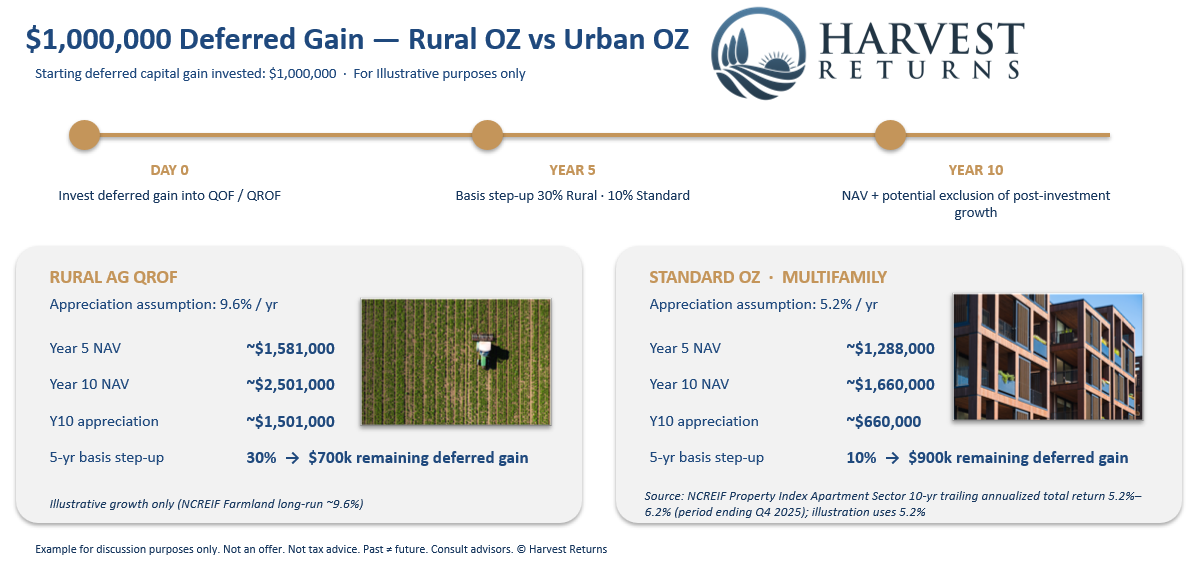
Side-by-side illustrations (for example, $1 million of deferred gain comparing a rural QROF-style path to a standard multifamily OZ path) are useful for one reason: they show that both the 30% vs 10% step-up and the underlying asset-class assumptions matter.
How Harvest Returns fits
Harvest Returns is national agriculture investment platform founded in 2016. We diligence operators, live in production agriculture, and package access for high-net-worth investors, RIAs, and family offices. We’re preparing an upcoming Rural Agriculture Opportunity Zone Fund for early 2027.
If you’re an advisor, think of us as the specialist: you keep the client relationship; we bring ag underwriting and rural OZ structuring fluency.
What to do next
If you have (or expect) capital gains and want to learn about the Rural Agriculture Opportunity Zone Fund, complete our short interest form:
This article is for educational purposes only and not an offer to sell securities. Not tax, legal, or investment advice. Past performance is not indicative of future results. Harvest Returns is an Exempt Reporting Adviser, not a registered investment adviser or broker-dealer. Consult your own advisors.